
Your first month is free.Add code at checkout.

Health and Safety

Manual handling: online training course

How lifting, carrying, pushing and pulling cause injury, how to size up a load before you move it, and how to handle it in a way that protects your back.

Illustration for the Manual handling course
Time
20 minutes
Sections
6
Questions
5, 4 to pass
Certificate
PDF, on passing

Who it is for

Anyone who lifts, carries, pushes or pulls as part of their job: warehouse, retail, hospitality, trades, care, delivery and facilities staff, and office staff who move stock, furniture or equipment.

Why it matters

Muscle, joint and back problems make up about a quarter of all work-related ill health, and handling is behind nearly one in five reported workplace injuries. The course corrects the two things people most often get wrong: the “25 kg limit” and “keep your back straight”.

What it covers

6 sections, about 20 minutes.

Each section makes one point and can be read in a few minutes. Progress is saved after every one.

By the end, people will be able to

  • Explain what manual handling is and why it injures people
  • Size up a task, a load and the space before moving anything
  • Use a good basic technique for lifting and carrying
  • Know when to use equipment or ask for help, and when to stop

Law and guidance it draws on

  • Manual Handling Operations Regulations 1992 (and the Northern Ireland equivalent)
  • Health and Safety at Work etc. Act 1974, section 7: employees’ duties
  • Health and Safety Executive guidance L23 and INDG143
  1. 1

    What manual handling is

    What counts as manual handling, and how many people it injures each year.

    Includes key figures
  2. 2

    What the law expects

    The employer’s duties in order (avoid, assess, reduce), your own duties, and why there is no legal weight limit.

    Includes a step-by-step guide
  3. 3

    Size it up before you move it

    How to size up the task, the person, the load and the place, with the official guideline weights.

    Includes a side-by-side checklist and a scenario
  4. 4

    A good basic lift

    The principles of a good basic lift, step by step.

    Includes a step-by-step guide
  5. 5

    Pushing, pulling, equipment and teamwork

    Pushing and pulling, using handling equipment, and lifting as a team.

    Includes myths and facts
  6. 6

    Speak up early

    Why reporting aches and hazards early matters, and who to tell.

    Includes a step-by-step guide
  7. Check your knowledge

    5 questions on what has just been read. 4 correct answers complete the course and produce the certificate. For example: “What is the legal maximum weight one person may lift at work?”

From the course

What would you do?

Every course includes a scenario like this one. It is not scored: choosing an answer explains why it is right or wrong, which is how people remember it.

A delivery of printer paper has been left in reception. Each box weighs 12 kg and has no handles. The storeroom is up one flight of stairs and you have ten boxes to move. What do you do?

  1. ACarry two boxes at a time to get it done quickly
  2. BCarry them one at a time, bending your knees
  3. CStop and ask whether they can be stored downstairs, or moved with a lift or a trolley, before carrying anything
Show the answer

C. Right. Avoiding the carry comes first. If it cannot be avoided, split the load, share the job and take breaks.

In LeaveWise

Assign it, and know when it is done.

This course is one of 14 in Learn, part of every LeaveWise plan. Here is what happens once you assign it.

How Learn works

Give it to the right people.

Assign Manual handling to everyone, a department, a location or named people, with a due date if you want one. Make it mandatory and new starters are given it automatically. Each person gets an email with a link straight to the course, and it appears on their Dashboard.

  • Reminders a week before, the day before and while overdue
  • A Monday list of overdue training for managers
  • Optional renewal, for example every year
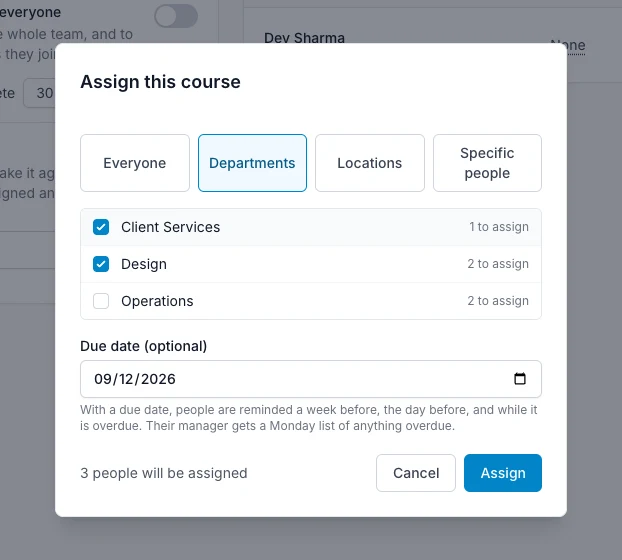
Assign this course dialog with departments selected and a due date

See who has completed it.

When someone passes, their manager is emailed and the training record shows a tick with the date. You can see at a glance who has finished, who is part-way and who is overdue, and download the list or any certificate as evidence.

  • Completion email to the person’s manager
  • PDF certificate with name, date, score and reference
  • Training record you can filter and download
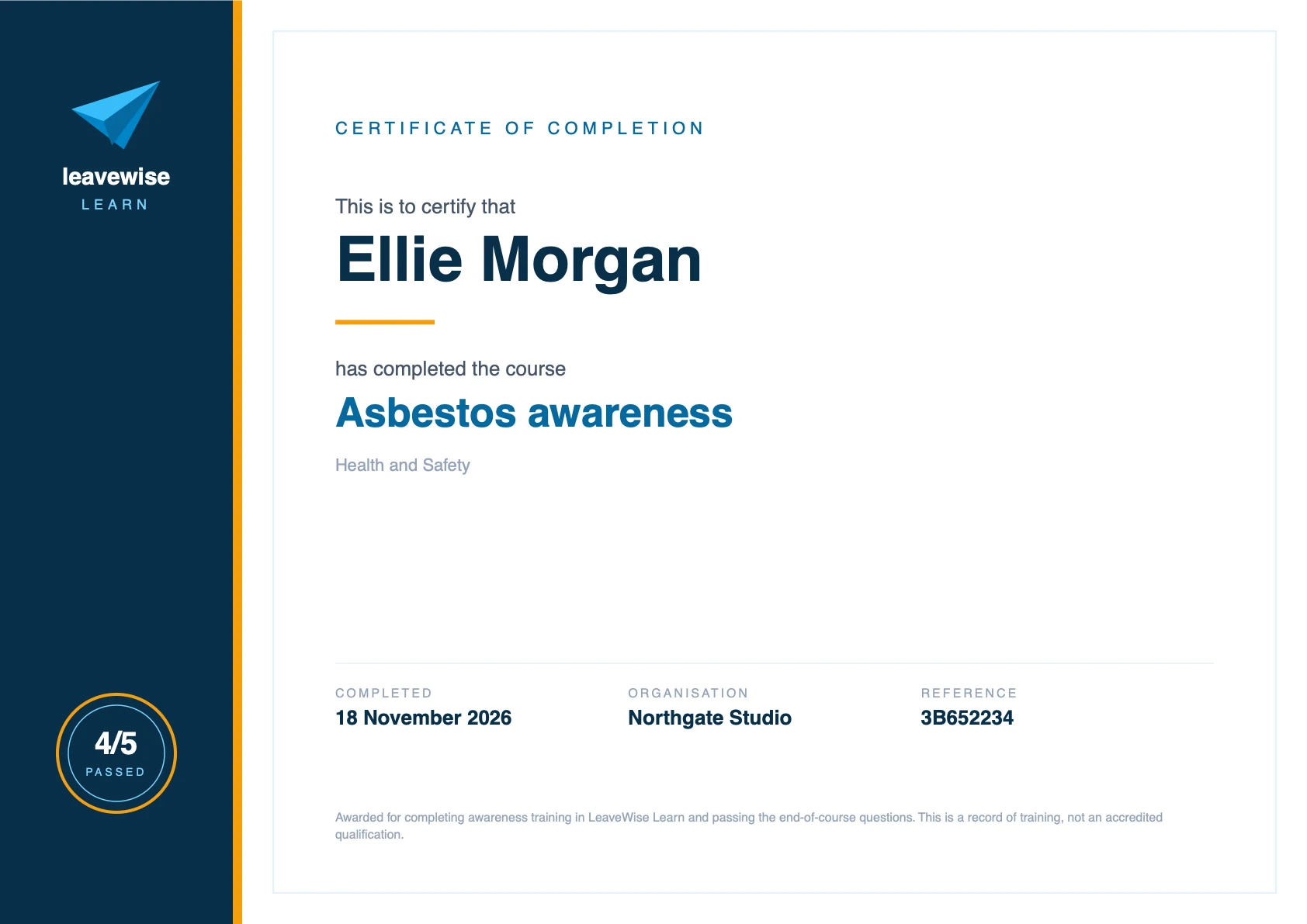
LeaveWise Learn certificate of completion showing the person’s name, course, score, date, organisation and reference
FAQ

Questions about
this course

Something else on your mind?
Talk to us

Are the training courses included in the price?

Yes. Learn and every course in it are part of every plan, from £4.99 a month for up to 5 users. There is no charge per course or per learner, and new courses are added to your account as they are released.

How long does a course take?

Between 15 and 30 minutes. Each is a few illustrated sections followed by five questions, and four correct answers are needed to pass. People can stop part-way and carry on later, and try the questions again if they do not pass first time.

Do staff get a certificate?

Yes. Passing the questions at the end of a course produces a PDF certificate with the person’s name, the course, the date, the score and your organisation’s name. They can download it at any time, and so can their manager and team admins.

Can I see who has completed their training?

Yes. The training record shows every person against every course: completed with the date, in progress, not started or overdue. You can filter it by department or location, download it as a spreadsheet, and download any certificate from it. Department managers see the same record for their own departments.

Can I make a course mandatory for new starters?

Yes. Switch a course to “Mandatory for everyone” and it is assigned to the whole team with a due date, and to every new starter automatically when they join. You choose how many days people have to complete it.

Are the courses accredited?

No. They are awareness training written for UK workplaces: general guidance that helps people understand a subject and what is expected of them. The certificate is a record that a named person completed the course and passed the questions on a given date. Where the law requires formal, practical or accredited training, the courses support it but do not replace it.

Get started today

Give your team Manual handling, and keep the record.

Every course, certificate and reminder is included in every plan, from £4.99 a month for five people.

Get started with LeaveWise See pricing Monthly billing. No contract. Cancel any time.